
 Forgot your password?
Social Impact Assessment (SIA) Concerns raised by Metro OSD
The SIA defines the immediate area for its assessment by taking 22 small statistical areas around the site and then compares Australian Bureau of Statistics (ABS) figures for this combined area with the Sydney LGA and Greater Sydney. The problem with this approach is that the area defined includes some of the most well-off parts of the area and some of the least well off. This is clearly seen if you look at the ABS Socio-Economic Indexes for Areas (SEIFA) that ranks each of these small statistical areas according to relative socio-economic advantage and disadvantage. Statistical areas towards Mitchell Road and Fountain Street Alexandria rank in the most advantaged areas and those exclusively public housing areas on the Waterloo Estate in the most highly disadvantaged. Combine the areas and they look average, but this hides important impacts on those most likely to be impacted and with least capacity to deal with any impact. As a result, conclusions drawn from the SIA’s approach do not explore potential impacts on surrounding public housing tenants nor how these impacts might be mitigated.
Where there are significant differences within an area, as there is in Waterloo and surrounding Alexandria and Redfern, it is not adequate to look at a statistical average. Different communities will possibly be impacted differently by a development. The SIA does not look at the potential impact on the most marginalised, who also will live closest to the re-development. As a consequence, the SIA ignores even acknowledging the adverse interactions in the earlier stage of this development between the developer and its local neighbours and local public drinkers.
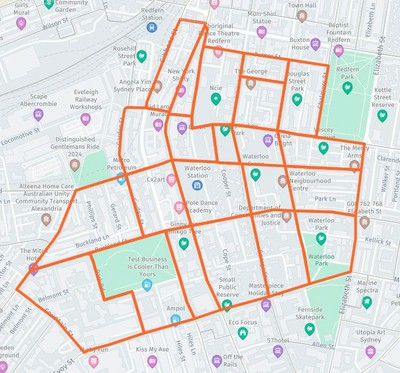
REDWatch has strongly suggested in its SIA interview that rather than pay to have off duty police at the site so that the workers will work, the developer needs to train its contractors how to deal with people who have suffered trauma and have complex issues as well as having mechanisms for de-escalating situations that arise. The SIA does not even mention this historical social impact nor how it might be better handled in the future.
The community facilities section of the report is also not up to the standard the community should expect of an SIA. For example, three Aboriginal Organisations (AMS, AHC and Mudgin-Gal) are mis-located on the facilities map in the report. Other key community facilities like Counterpoint Community Services’ The Factory and its Multicultural Services are not included at all, along with a number of other local NGO services. The community facilities recognised include the LAHC owned James Cook Community Garden and LAHC owned Waterloo Green described in the report as “an open community park situated to the north east of the redevelopment” – land which after a new Waterloo Park is built is most likely destined for redevelopment rather than staying LAHC owed open space and gardens. Some local health facilities have been included while others ignored.
All of this supposedly exists to identify what is already in the area and hence what needs to be provided as community facilities by this development. While the Waterloo Metro OSD only expects to generate a need for 17 children aged 0-4 the SIA argues that additional childcare facilities will be needed to service the population increase associated with ongoing development in Waterloo and the OSD is keen to provide those childcare places (which a provider will undoubtably pay for). It is instructive then to look at how the SIA looks at child care facilities in the immediate area.
The SIA says “A desktop audit of childcare facilities found that there are no childcare facilities within 400m of the site, specifically none within the immediate social locality, as indicated by the Social Locality map in Chapter 5. The closest facilities are SDN Redfern, SDN Waterloo, and The Green Elephant Waterloo, each located approximately 1.5 km away. Refer to Appendix B.”
So those who know the area will know that SDN Waterloo (Louis Barker) is within 300m of Waterloo Metro. They would also know that SDN Redfern is about 450m away and Green Elephant Waterloo within 800m. A quick check of Google maps shows the following are also within an 800m radius - Eveleigh Early Leaning Preschool, KU Sunbeam Pre School, KU James Cahill, Honey Bird Childcare and Wunanbiri Preschool. It is particularly worrying that an incorrect SIA can be used to advance a developer’s preference for the provision of facilities over other possible community facilities uses.
One of the flaws in the earlier community facilities studies was to not assess the suitability of the buildings used by existing community facilities and to assume that they could continue to provide services from those locations into the future, when many organisations are not in premises that are fit for purpose or for which they are paying rent not covered in their funding. The option of providing community facilities for a not-for-profit agency should have been considered if the community facilities review had adequately assessed facilities rather than the services they managed to provide.
It is also worth mentioning that classic SIA approach for assessing the accessibility of local facilities by if they fall within certain radii of the development is flawed if there are major physical barriers, like the railway corridor, to access a facility. So, the SIA says Carriageworks is within 1 km of the site when by foot or car it is actually 1.3km away and will remain so until the community gets the NSW Government to deliver the 2004 promised bridge across the railway corridor at Carriageworks.
There are variations of the Social Impact Assessment for each of the DAs, above we have drawn on those from the Second Amending Concept SIA. We encourage readers to have their own look at this report as we are sure that there will be other areas where people will have concerns. For example, we have not gone into the grading within the report where the assessing of increased housing supply in accessible locations? is assessed as a “high positive” when the oft referred to affordable housing only remains affordable for 10 years.
At a basic level community members need to be able to recognise their community accurately described in such reports. There is a long history of inadequate desktop community facilities and social sustainability reports for Waterloo that have been roundly criticised by REDWatch and other agencies.
In part this seems to come from developers expecting consultants to do cheap desktop studies requiring little understanding of what is on the ground. SIAs need to accurately assess impact, especially on those most impacted and seriously address how any impacts can be mitigated. This is especially so when dealing with vulnerable communities like those in public housing.
Hopefully when Stockland presents its SIA for Waterloo South, the SIA will not contain such fundamental errors and Stockland will insist on a much more robust SIA that assesses the impact of the development on the public housing tenants directly impacted by the redevelopment and how those impacts can be mitigated.
If you want to look further at the demographics of the area you can look at different statistical areas for your local area at https://atlas.id.com.au/sydney/
Source: Adapted from REDWatch Email Update 7 January 2026. On 12 January 2026 REDWatch added the additional concern about the SIA and EIS on this project.
Waterloo Metro Developer reduces community facilities
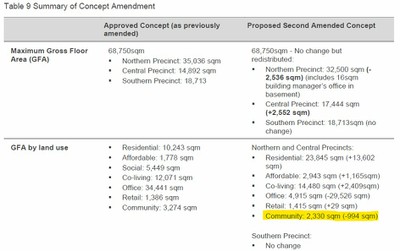
The Waterloo Metro developer wants to reduce community facilities floorspace by 994sqm. That is space that could be used by local community controlled not for profits. The table opposite compares what is approved for the site with what the developer is asking to change.
Also, the Social Impact Assessment says: “This Second Amending Concept DA alone will not generate enough demand for a purpose-built childcare facility” (Concept SIA p40). But the developer only wants to deliver a “community centre in the form of a childcare centre” (Concept SSDA p40) even though the developer’s own figures show they do not generate enough childcare need to justify its childcare proposal.
There are community-controlled organisations that need low-cost permanent facilities but don’t have them. There are others that operate from inappropriate spaces to deliver their services. At the same time the Waterloo Metro developer is trying to avoid providing that kind of community facilities benefit.
Actual community facilities have to be provided to a non-government organisation or a Council while health facilities and childcare facilities can be provided to for profit providers at commercial rents. Understandably developers prefer spaces they can maximise income from.
If you don’t think the developer should not get away with this change, we encourage you to object irrespective of any other views about the project you might have. If you have already made a submission but missed this element, because it is not spelt out in the text of the proposal, please make a short additional submission on this.
In REDWatch’s last email update, we drew attention to the Metro Site Second Amending Concept Social Impact Assessment (SIA) that did not properly look at the needs of local community facilities and also misrepresented the amount of child care facilities in proximity to the Waterloo Metro site.
You can object to the change of community facilities change of use proposed in the Second Amending Concept Plan (SSD-79307765) at https://www.planningportal.nsw.gov.au/major-projects/projects/waterloo-metro-quarter-second-amending-concept
Please also note that the Planning NSW website is now showing 15th January as the cut off for submissions rather than the initially advised 14th January.
REDWatch apologises that the reduction in community facilities space has only recently been identified. While it appears in this table the reasons for the reduction is not covered in the text of the EIS. As a result, it was not covered in our earlier email updates hence this small update to alert you.
Source: Adapted from REDWatch Email Update 12 January 2026


